





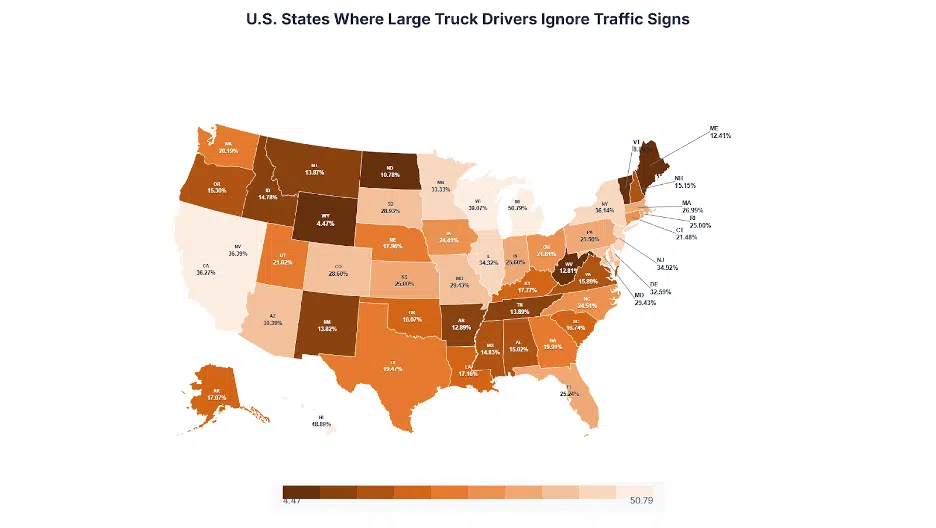
As large trucks move through intersections, highway corridors, and urban delivery routes, adherence to traffic signs remains a critical determinant of roadway safety. Across the United States, crash data shows that when commercial drivers fail to obey posted traffic controls, the likelihood of serious and fatal collisions rises sharply, with certain states experiencing far greater risk than others.
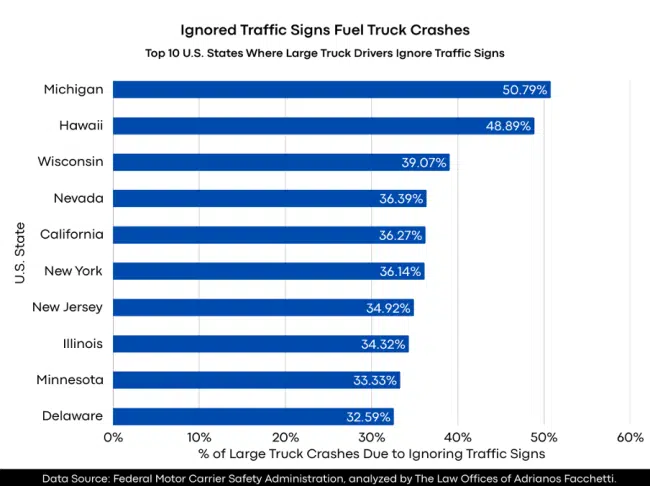

The research by a Burbank-based personal injury law firm, the Law Offices of Adrianos Facchetti, analyzed large truck crash data from the Federal Motor Carrier Safety Administration’s Crash Data Analysis and Statistics (CDAN) system. The study examined average annual crash figures from 2019 through 2023, focusing on total large truck crashes and those specifically attributed to drivers ignoring traffic signs. Each state was evaluated based on the proportion of truck crashes linked to traffic sign violations, and states were ranked to identify where this behavior poses the greatest danger to motorists.
|
Top 10 U.S. States Where Large Truck Drivers Ignore Traffic Signs |
||
|
U.S. State |
% of Large Truck Crashes Due to Ignoring Traffic Signs |
Rank |
|
Michigan |
50.79% |
1 |
|
Hawaii |
48.89% |
2 |
|
Wisconsin |
39.07% |
3 |
|
Nevada |
36.39% |
4 |
|
California |
36.27% |
5 |
|
New York |
36.14% |
6 |
|
New Jersey |
34.92% |
7 |
|
Illinois |
34.32% |
8 |
|
Minnesota |
33.33% |
9 |
|
Delaware |
32.59% |
10 |
New York ranks sixth for large truck crashes involving ignored traffic signs, with 36.14% of incidents linked to this factor. Between 2019 and 2023, New York averaged 199 large truck crashes annually, including 72 crashes each year caused by drivers failing to obey traffic signs.
Commenting on the findings, a spokesperson from the Law Offices of Adrianos Facchetti said:
“Large trucks carry immense weight and force, so when traffic signs are ignored, the consequences can be catastrophic. Our analysis shows that in several states, a staggering share of truck crashes stem from basic traffic control violations. These are preventable incidents, and stronger enforcement, training, and accountability can save lives.”
What Drivers, Carriers, and Policymakers Should Know About Truck Sign-Compliance Risk
Here’s your strategic roadmap:
Targeted enforcement at known high-risk junctions
- Increase targeted enforcement focused on commercial vehicle compliance with stop signs, red lights, and other posted controls in high-violation states
- Prioritize enforcement at intersection clusters and freight corridors where sign-violation crash shares are elevated
- Use violation-linked crash concentration to guide patrol allocation and operational timing (peak freight movement windows)
Training and fleet controls that reduce “missed sign” crashes
- Expand safety training emphasizing intersection approach discipline, signal scanning, and speed management for commercial drivers
- Reinforce procedures for complex environments such as multi-lane arterials, urban deliveries, and highway ramp terminals
- Encourage carriers to adopt recurring refresher training when internal safety reviews show sign-violation exposure
Roadside and signage reliability improvements
- Improve visibility and maintenance of traffic signage in high-truck-traffic corridors, especially where sign conspicuity may be compromised
- Audit high-volume truck routes for sign placement, obstruction issues, and readability consistency
- Coordinate road agencies and freight stakeholders to prioritize fixes at locations with repeated sign-related incidents
Methodology
The study was conducted by The Law Offices of Adrianos Facchetti, a Burbank-based personal injury law firm that specializes in car accidents, motorcycle crashes, wrongful death, and catastrophic injuries.
The study analyzed large truck crash data across U.S. states from 2019 through 2023 sourced from the Federal Motor Carrier Safety Administration’s Crash Data Analysis and Statistics (CDAN) system. Multi-year annual averages were calculated for total large truck crashes and crashes attributed specifically to drivers ignoring traffic signs, allowing the analysis to assess the prevalence of traffic control violations by state. Percentage shares were then used to rank states, highlighting where failure to obey traffic signs contributes most significantly to large truck crash risk and severe roadway outcomes.
Data Sources:


